
Life Is Humbling
Even on your best nights.

There are meals you make.
And then there are meals you commit to.
Spanakopita—a traditional Greek spinach pie made with layers of delicate, paper-thin phyllo dough wrapped around spinach, feta, and herbs—falls firmly in the second category.
It’s also a dish I used to make with my mother, who was neither Greek nor inclined to let that stop her, and who is no longer here on planet earth to supervise my technique. Making it now feels like a small, loving act of remembering her, one that carries me straight back to my teenage years when we would make it together for special occasions.
You know, like “It’s Tuesday and I want spinach, but devoid of all its nutritional properties.”
Spanakopita is not a “throw something together” kind of meal. It’s a dish you engineer, and the filling makes it or breaks it. You season as you go, and then you keep seasoning—tasting, adjusting, trusting your instincts as the day unfolds.
It’s also unapologetically rich: eggs and cheese—feta, ricotta, and cottage cheese, in my case, courtesy of a recipe passed along by actual Greek people, so we’re all going to relax about it.
Lacking a lasagna pan big enough, I split it between two cast-iron pans.
I leveled up.
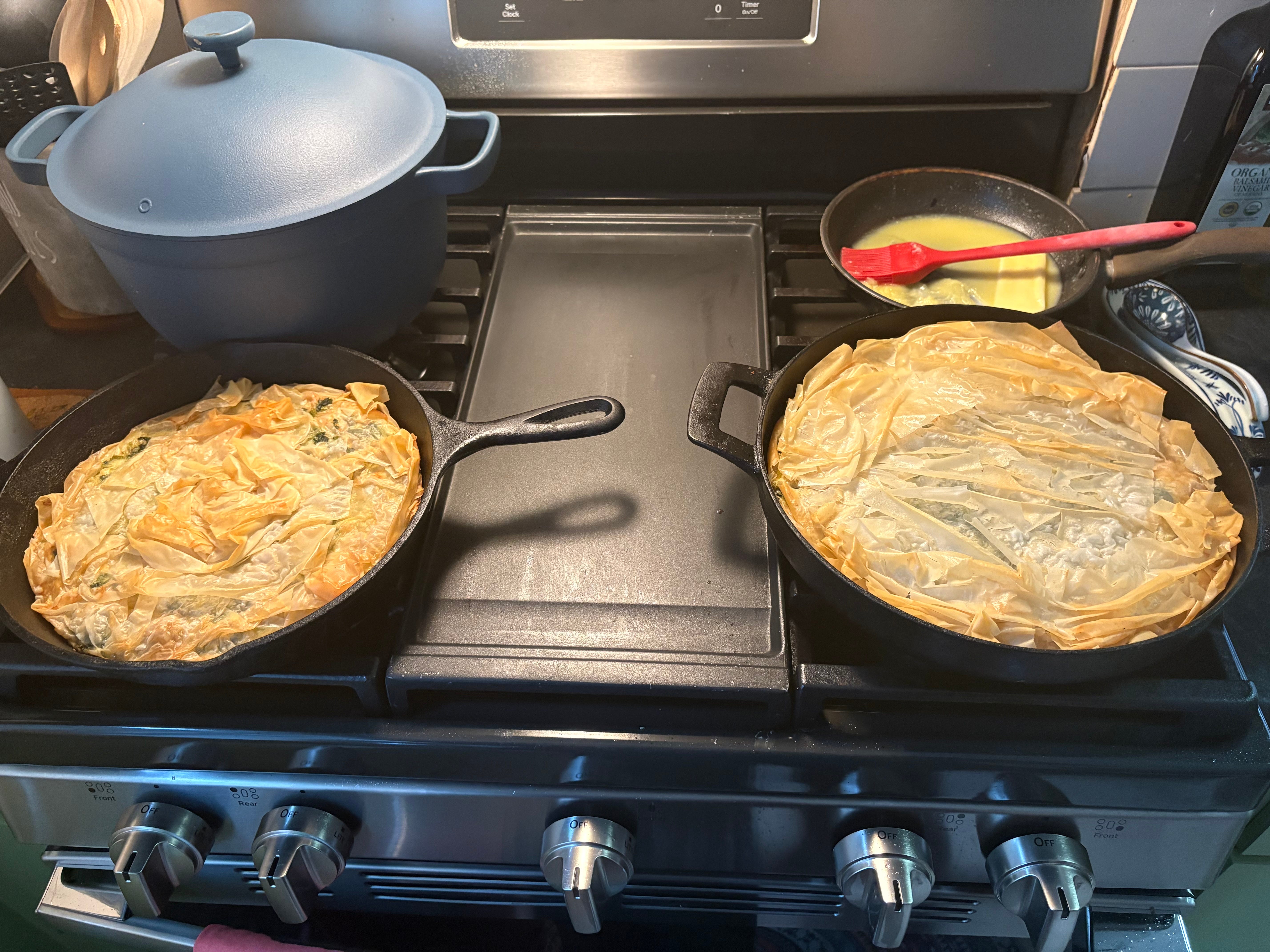
The butter situation alone should include a medical disclaimer. There’s enough of it to warrant serving Lipitor as an appetizer. I melted a stick of butter in one cast-iron pan and used it to build the layers of the first pie in the other, leaving that pan perfectly greased and ready for its own turn. Then I melted a second stick—yes, a second—into a third pan and used that to construct the layers of the second pie.
Which is why—naturally—I chose to make it on a day that had already gone completely sideways.
From the first call of the morning, it was clear I had entered what can only be described as The Goat Rodeo Dimension. Every conversation ran long. Every “quick thing” revealed itself to be anything but. My calendar, that optimistic little grid of good intentions, betrayed me at every turn.
And as usual, I found myself thinking: of course this is happening right now.
Because I am, as I’ve documented, a proud member of the 1% of exceptional situations. (If you’ve missed that particular personality trait, you can read about it here.)
So there I was—behind, slightly feral, but steadfast in my commitment to handcrafting a Greek spinach pie as if I had nothing but time and a gentle breeze at my back.
And yet.
Somehow, I pulled it all off.
The spanakopita came together. The layers behaved. The filling was exactly what it needed to be. I even had time for a hot shower before the doorbell rang, which frankly deserves recognition as both an athletic and culinary achievement.
With minutes to spare before opening the door, I found the perfect dinner soundtrack—Dave Brubeck Jazz on Spotify—and opened it with what I can only describe as grace and aplomb, considering the day I’d had.
My friends arrived bearing exactly what you hope your friends will bring when you say “I’m making spanakopita”: a Greek salad with a dressing so good it should be patented, and an assortment from a Greek bakery—baklava in all its forms: chocolate, fig, traditional—the kind I will think about on my deathbed for its abject perfection.
Dinner unfolded the way you wish more evenings would.
Conversation flowed as easily as the wine. Stories overlapped. Laughter came in waves. These are friends from different chapters of my life, the kind who don’t all know each other equally well but somehow fit together seamlessly at the same table.
We ate. We lingered. And, true to our middle-aged form, we were collectively delighted when the evening wrapped up around 8:30, leaving plenty of time for everyone to be home and in bed by 10.
No notes.
After hugs were exchanged and leftovers distributed, I stood on the porch and waved as taillights disappeared down the street. Then I went back inside, cleaned up the kitchen, and let the quiet settle around me.
And then I did something I don’t always give myself permission to do.
I paused.
I stood there and took stock—the meal, the laughter, the work I’ve built that allows for nights like this, the friends who represent different chapters of my life, and yet somehow all belong in the same room. It was one of those moments that feels almost cinematic, where you can sense the shape of your life and think, yes…this. This is the way.
All that was left was one final, small domestic task: toss the table linens into the wash and head upstairs to bed.
As I opened the basement door and turned on the light, I suddenly heard myself say, “Why is there water all over the cellar floor?”
Not a little water.
Water.
My basement floor was covered, and my water heater—apparently eager to participate in the day’s events—had chosen that exact moment to give up entirely.
And, as if on cue, I had started the dishwasher mere minutes before—loaded with approximately every single piece of silverware and dinnerware I own.
Naturally.
So I did the only thing that made sense at 9 p.m. on a night like this.
I texted my plumber, Sean.
“We had a good run. The water heater died, and the basement is covered in water. Bonus: I just turned the dishwasher on.”
Sean, blessed man that he is and always inclined to give me far more credit than I deserve, asked if I knew how to shut off the water heater.
“Absolutely not,” I said.
He called me right away and calmly walked me through how to shut off the tank.
Because the truth is, this wasn’t entirely a surprise. I already knew my water heater—and the one for my upstairs rental—were operating on borrowed time. In a deeply satisfying moment of foresight (my superpower), I had signed a quote with Sean in the dead of winter to replace both in the spring.
Two weeks ago, I had even confirmed that we were ready to move forward now that we were no longer living in a snowy hellscape.
So when the inevitable finally arrived, I wasn’t starting from scratch.
I was continuing a plan.
And when I looked around, really looked, the situation—much like the rest of the day—was not nearly as catastrophic as it first appeared.
This is a 120-year-old New England basement. Unfinished. Clay floor. The water hadn’t risen. Nothing was floating away into the night.
It was simply damp.
Manageable. Contained.
Within forty-eight hours, it was almost completely dry.
And because God has a great sense of humor and tries all His best material out on me, Sean told me he had been planning to call me the very next day anyway to see if he could come by Monday.
“Yes,” I said. “Please do.”
There was no scramble. No disruption to speak of. As it happens, the upstairs unit is currently empty, which means I can shower there while everything gets handled—a small, practical buffer I hadn’t fully appreciated until I needed it.
So there I was, not long after hosting a dinner party where I made spanakopita from scratch on a day that tried its best to take me out, standing in a damp basement and noticing something had shifted.
Not the circumstances.
But me.
The dinner was still perfect. The laughter still lingered in the house. The sense of a life well-lived hadn’t gone anywhere.
And instead of unraveling at the first sign of something going wrong—the way I used to, catastrophizing like my life depended on it, getting ready to bitch about it to anyone and everyone with an exposed epidermis, and for added fanfare contemplating a full-page ad in the Boston Globe or a billboard on Route 93—I found myself moving through it calmly, practically, almost without fanfare.
Which, in its own way, felt like the true victory.
Because life will always have its timing. It will give you the beautiful, fully-formed moments—the meal, the people, the sense that you’ve built something meaningful—and then, without asking your permission, it will place something inconvenient right beside it.
Not to cancel it out.
To remind you that both belong.
Life is humbling like that.
And every now and then, it quietly shows you that you’re better at living it than you used to be.
Also, credit where it’s due: this title comes courtesy of my friend and fellow Substack writer, Beth Knaus, who offered it up when I regaled her with this story. (I didn’t say I wouldn’t bitch about it to some people. I’m not that evolved yet.) Check out Beth’s Substack here.
And the spanakopita itself? That credit belongs to my niece, Nisha Mehling Galione, whose recipe made the whole evening possible.
Writing—like spanakopita—is not a “throw something together” kind of endeavor. It’s engineered. It’s layered. And when it’s done well, it holds up under pressure.
If your message needs that kind of structure and clarity, that’s exactly where I come in.
Your description of spanakopita made me want to go directly to the nearest Greek restaurant. Ha! Lucky for me there's a Greek restaurant about a mile from my home and that's going to be lunch today!
Thank you for sharing this story. I enjoyed it immensely. I will think of you when I make a couple of Greek dishes in the coming days, using the amazing barrel-aged Feta I discovered at a Greek market in downtown Detroit earlier this week.